Automated cell culture
Trilobio automates media exchange, feeding, and passaging on a fixed schedule, so your cells get maintained on time whether or not anyone's in the lab.
Cell culture automation on Trilobots
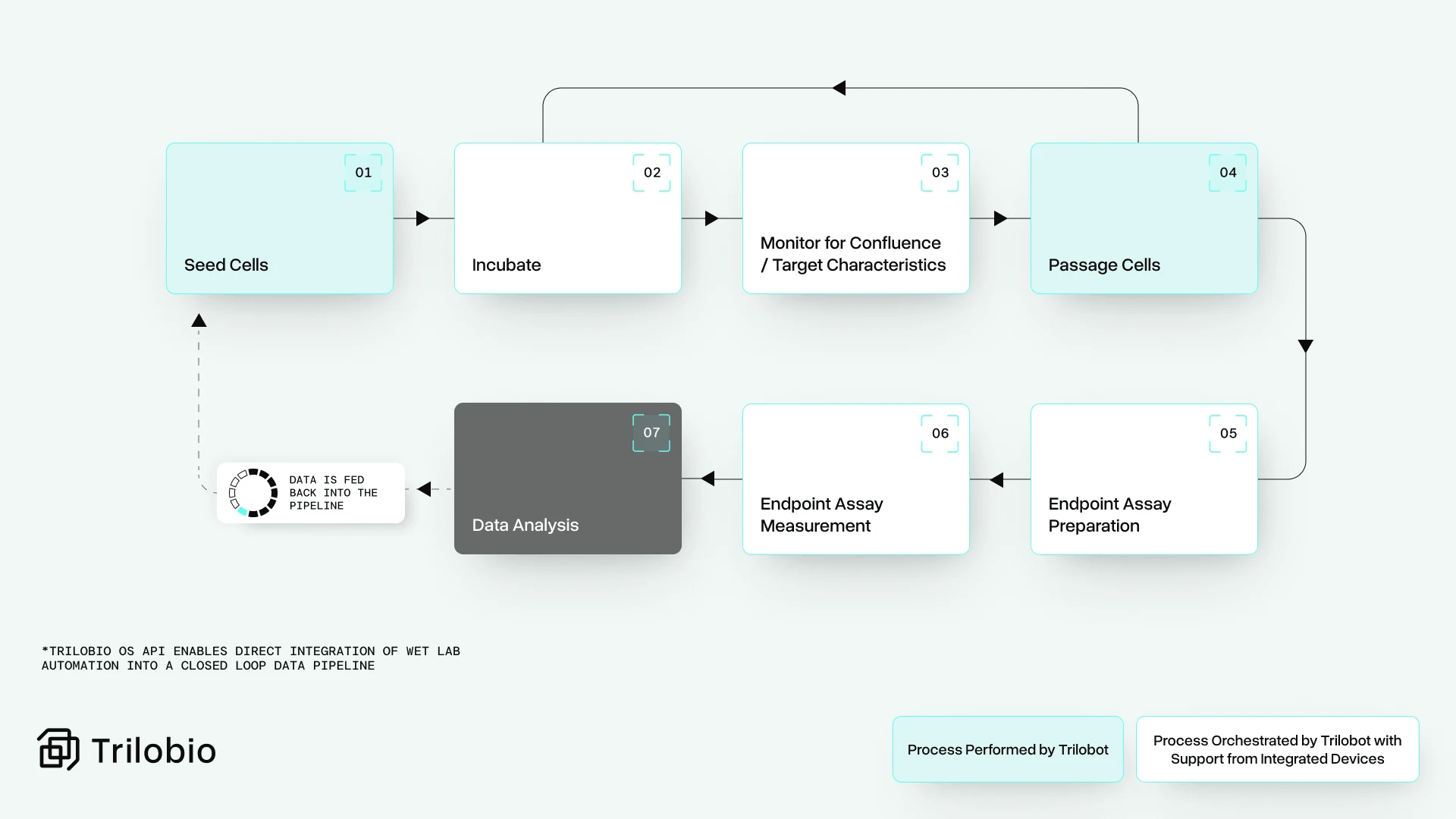
Cell culture runs on a long clock. Cultures grow, get fed, and get tested over days or weeks, and someone typically has to be in the lab on a strict schedule no matter what day it lands on. The Trilobot takes over that core liquid handling itself, from feeding to swapping out spent media. Whatever your process looks like, the Trilobio platform is built with flexibility to support it.
Start small, scale when you’re ready
Trilobio scales with your lab. Start with a single Trilobot and add capacity as your cell culture workflows grow, without re-architecting your process. Because the platform is flexible by design, the same system that maintains your cultures today can pick up new steps (a different media formula, a new feeding interval, even a different assay entirely) as your process changes.
What is cell culture?
Cell culture is the foundation almost every drug discovery workflow is built on, whether you're running passaging cycles to keep a line alive or testing drug efficacy against a growing population, you need cells, and you need them maintained reliably. The core building blocks are largely the same across labs: bacterial and mammalian cells, core human cell types, and (increasingly) stem cell lines, whether grown adherent on a plate or suspended in liquid, each with its own media and handling requirements. Cell culture is a "hurry up and wait" process, where the real time spent isn't on a single pipetting step, but rather keeping a strict maintenance schedule over days or weeks. Manual processes can break down (for example, a missed feeding, a late media exchange, or an inconsistent hand-off between passages) and can threaten a culture. Cell culture automation matters more for reliability and walkaway time than raw throughput. That's the workflow Trilobio automates.
Challenges of manual cell culture
Benefits of cell culture automation
Built-In Reliability
Consistent liquid handling at every step means data quality reflects your biology, not variability introduced at the bench.
Full Walkaway
Load your samples and walk away. Trilobot runs multi-step protocols unattended—no babysitting required.
More Data Points Per Plate
Because the system is integratable with your assay setup, every well can run a different condition instead of duplicating one, giving you more usable data out of each plate.
Lower Contamination Risk
Every Trilobiot is enclosed and HEPA-filtered, keeping your samples sterile from start to finish.
End-to-End on One Platform
More of your workflow runs on one platform, so you spend less time managing instrument handoffs and more time on the science.
Run-to-Run Reproducibility
Every sample follows the same protocol to the same specification—no operator variation between technicians or across runs.
Flexible by Design
Swap tools, scale volumes, change formats—the Trilobot adapts to your workflow, not the other way around.
Starts at $25k/year
Full lab automation starting at $25k/year—less than most labs spend on a single liquid handler.
.webp)
Frequently asked
questions
Explore how automated cell culture works, what makes it different with the Trilobot, and how Trilobio transforms everyday biology workflows.