ELISA test automation
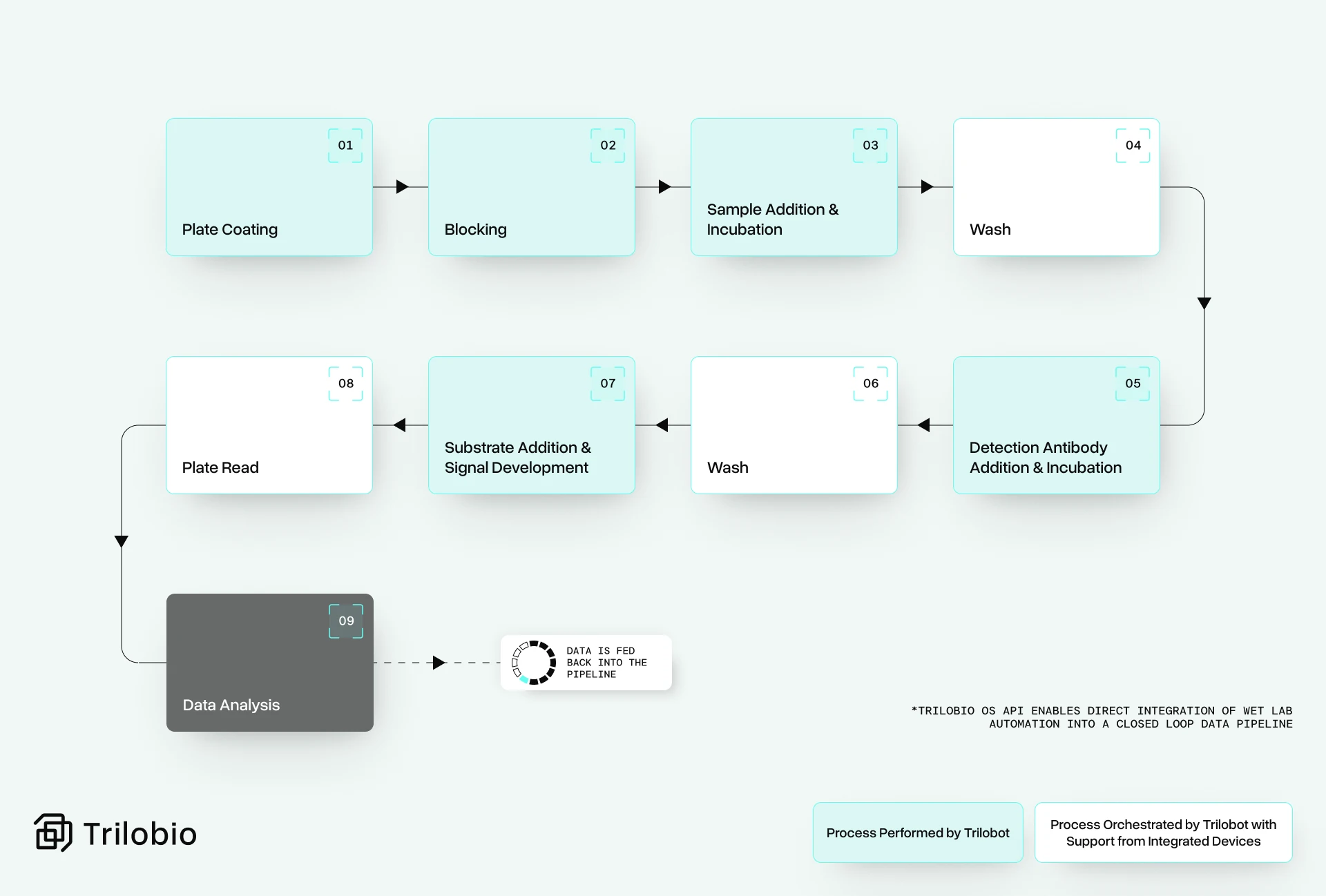
From coating plates to final reads, the Trilobot handles the incubations, washes, and reagent treatments that make ELISA one of the most hands-intensive assays on the bench.
ELISA assay automation in Trilobots
ELISA protocols vary widely—some run in a couple of hours, others stretch to 12 hours or overnight with multiple incubation and wash cycles. That variability is exactly why manual execution is so hard to get right consistently. The Trilobot handles the full sequence of reagent additions, incubations, and wash cycles on deck, so your samples get prepped with minimal variability and no babysitting, regardless of how long the protocol runs.
Start small and automate at your own pace
We get it—you may not need a full automation buildout on day one. Start with a single Trilobot, prove out your ELISA workflow, and expand when your throughput demands it—without rebuilding your protocol or your setup from scratch.
What is an ELISA assay?
An Enzyme-Linked Immunosorbent Assay (ELISA) is a plate-based technique used to detect and quantify proteins, antibodies, hormones, and other biomolecules in a sample. It works by binding a target molecule to a plate surface, then using an enzyme-linked antibody to produce a measurable signal—typically a color change—proportional to the amount of target present. ELISA is a workhorse across immunology, diagnostics, drug development, and basic research, prized for its sensitivity and its ability to run at scale across 96- or 384-well plates.
Challenges of performing a manual ELISA test
Benefits of moving to an automated ELISA system
End-to-End on One Platform
More of your workflow runs on one platform, so you spend less time managing instrument handoffs and more time on the science.
Flexible by Design
Swap tools, scale volumes, change formats—the Trilobot adapts to your workflow, not the other way around.
Throughput That Keeps Up
As capacity needs grow, Trilobot scales with them without the prep becoming the bottleneck.
Starts at $25k/year
Full lab automation starting at $25k/year—less than most labs spend on a single liquid handler.
.webp)
Frequently asked
questions
Explore how ELISA test automation works, what makes it different with the Trilobot, and how Trilobio transforms everyday biology workflows.